
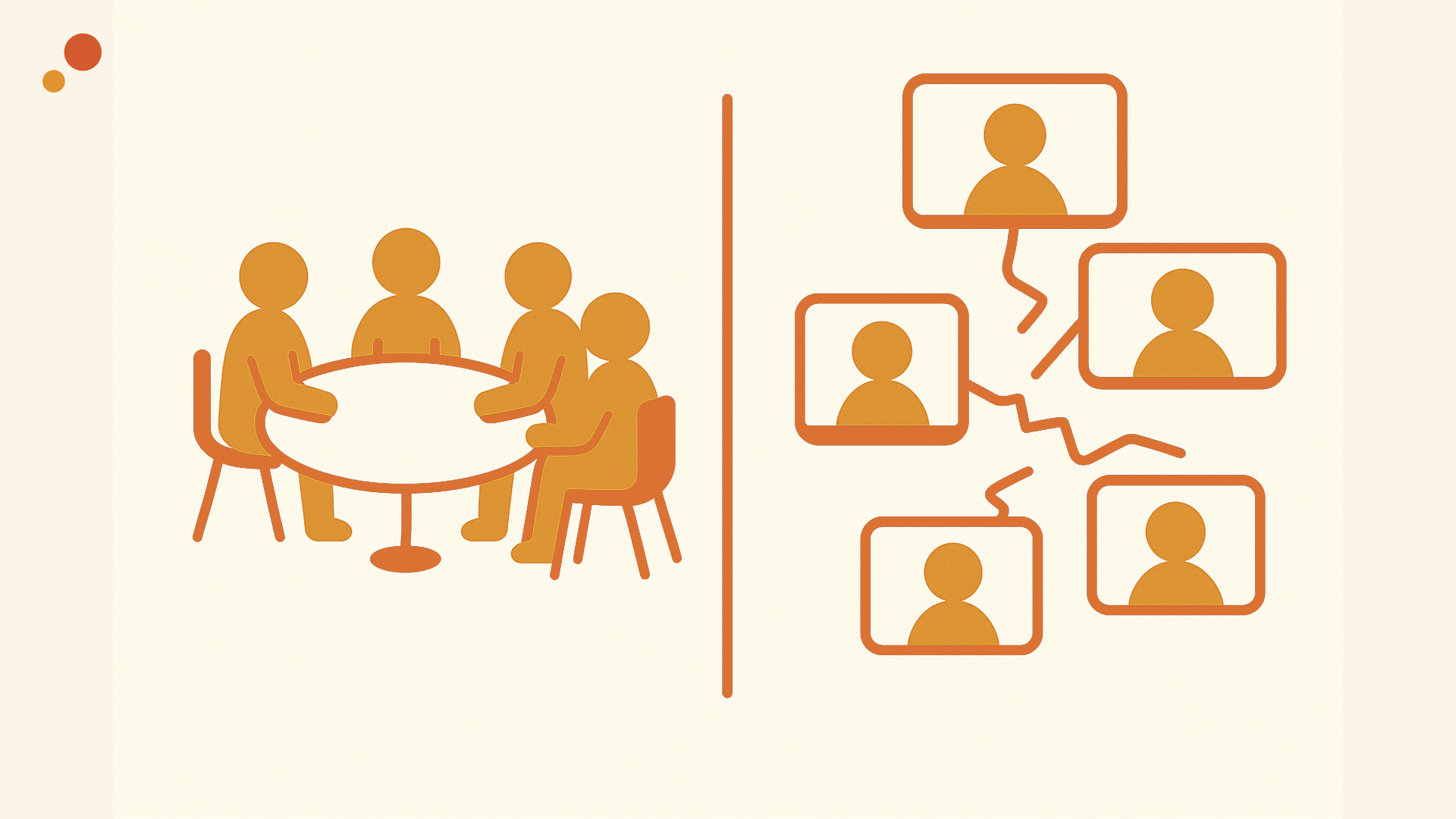
Your team started remote with fifteen people. Everyone knew what everyone else was working on. Slack felt like an extension of the office. Context was shared, not hoarded.
Now you’re at seventy-five people across four time zones.
And somehow, nobody knows what anyone’s doing anymore.
Your engineering team in Austin is building features your product team in Dublin didn’t ask for. Your customer success team in London is making promises your operations team in California can’t keep.
This isn’t a communication problem. It’s an alignment problem.
And Slack isn’t going to fix it.
The Illusion of Connection
Remote work sold us a lie… that more channels would create better alignment.
So we created more channels. #general. #product-updates. #engineering. #customer-feedback. Channels for everything.
We told ourselves: “It’s all documented. People just need to read the channels.”
But here’s what actually happens…
Your marketing manager misses the product roadmap update because it was posted at 3am their time. Your new developer can’t find the architecture decision from six months ago because it’s buried in a thread with 127 messages.
Digital communication tools created the appearance of transparency without the reality of alignment.
The Email Graveyard
So you tried email for the important stuff. Company-wide updates. Strategic priorities.
Your CEO crafts a thoughtful message about Q4 priorities. Sends it to the entire company.
Three weeks later, half the team is working on initiatives that directly contradict those priorities. Not because they’re ignoring them… because they never read the email. Or they read it once and forgot.
Email is where information goes to die.
The Growing Gap
At fifteen people, everyone’s in most meetings. Context spreads naturally. You understand not just what the company is doing, but why.
At fifty people, you start to miss meetings. You rely on summaries. You know what was decided, but not the reasoning.
At a hundred people, new people join who never experienced the early days. They’re trying to do great work without understanding how their work connects to anyone else’s.
The gap isn’t about communication frequency. It’s about shared context.
The Three Failures
Remote teams break down in predictable ways…
Strategic clarity disappears. Everyone knows their team’s goals. Nobody’s clear on the company’s priorities. Ask five people what matters most, get five different answers.
Operational coordination collapses. Engineering builds features that sales can’t sell. Marketing runs campaigns that product can’t support. Not because people are bad at their jobs… because nobody has visibility into what anyone else is doing.
Cultural cohesion fragments. Different offices develop different norms. New hires never quite absorb how things work here. People aren’t connected to something bigger than their immediate team.
These failures compound.
The Meeting Trap
So teams try to align through meetings. More all-hands. More syncs. More standups.
Now everyone’s spending twenty hours a week in meetings trying to understand what everyone else is doing.
And people still aren’t aligned.
Because most meetings aren’t creating shared understanding. They’re status updates. Information dumps. Everyone leaves with more information but not more clarity.
What Actually Works
The companies that maintain alignment at scale don’t try to communicate more. They build systems that create shared understanding naturally.
They make strategic priorities visible in the workflows where work gets done. They create clear line-of-sight from individual work to company outcomes. They turn institutional knowledge into accessible learning.
They build connection intentionally… not through forced fun, but through helping people understand each other’s work and contributions.
Beyond the Tools
Slack, email, Zoom… they’re useful tools. But tools don’t create alignment. Systems do.
Most remote teams are drowning in communication while starving for alignment.
They need fewer announcements and more conversation. Fewer updates and more context. Fewer channels and more connection.
The Real Cost
Misalignment shows up as missed opportunities. Duplicated effort. Good people working hard on the wrong things.
It shows up in talented new hires who still aren’t effective six months in because they never figured out how things really work.
It shows up in your best people leaving because they can’t see how their work matters anymore.
Making It Work
Remote work isn’t the problem. Remote work without alignment systems is the problem.
You can build a distributed team that moves as one. Where everyone understands not just what they’re doing, but why it matters and how it connects.
But not by sending more Slack messages.
You need infrastructure for alignment. Systems that create shared context. Workflows that maintain connection. Learning that transfers knowledge.
The companies that figure this out don’t just survive remote work at scale. They thrive because of it.
The companies that don’t keep hiring more people and getting less aligned.
Remote work revealed what was always true: communication isn’t alignment.
And alignment is what separates companies that scale from companies that just get bigger.